


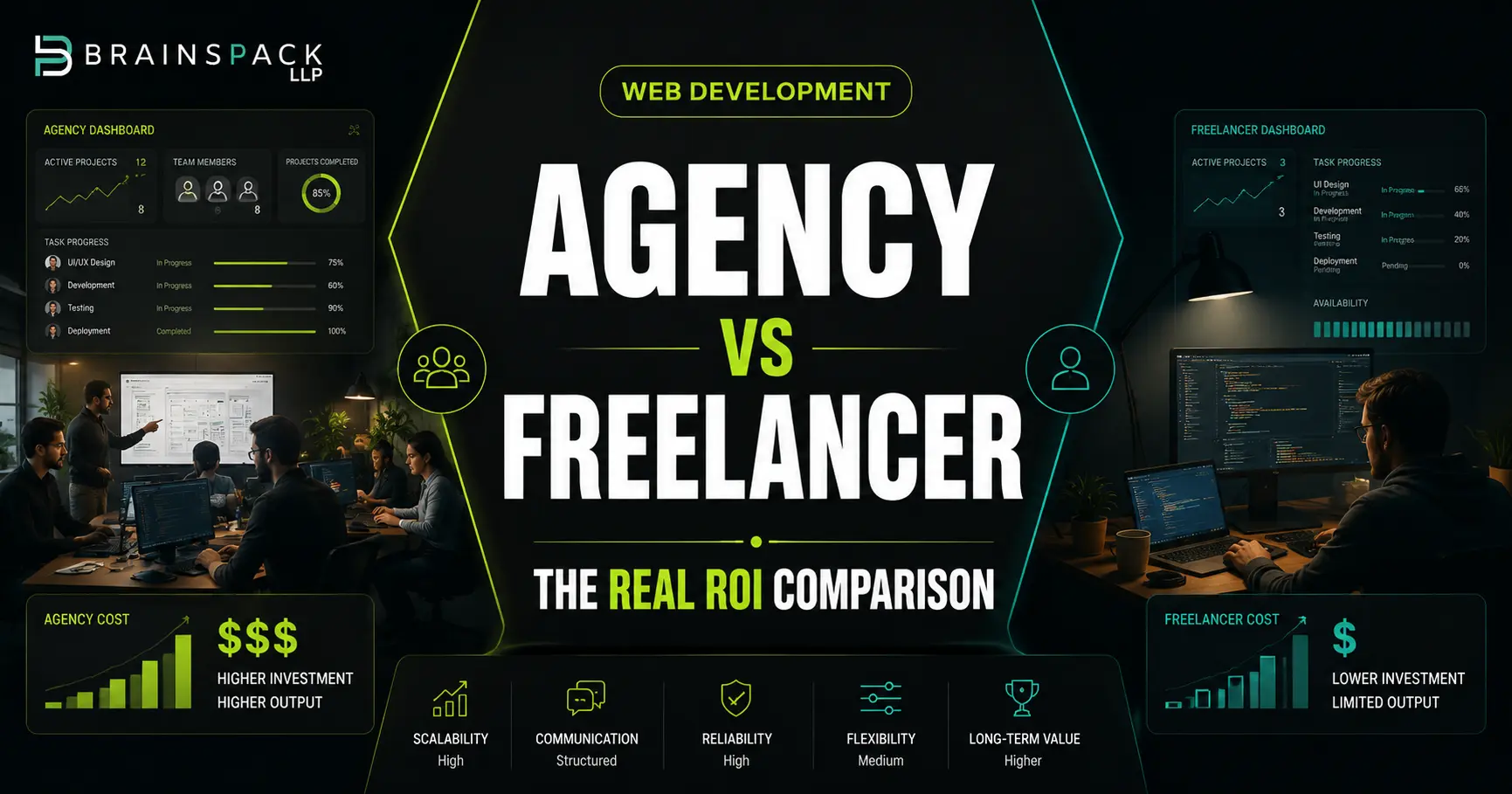
You’ve got a web development project. You’ve got quotes – one from an agency at $45,000 and one from a freelancer at $22,000. The math looks obvious, until you factor in delays, rework, QA gaps, and the management time you’ll personally spend. Suddenly the cheaper option might not be cheaper at all.
The agency vs freelancer web development debate is rarely a simple price comparison. It’s an ROI problem – and most businesses get it wrong because they compare sticker prices, not total cost of outcomes. This article draws on data from 50 real-world project comparisons, community discussions, and 2025–2026 industry benchmarks to give you a decision framework grounded in evidence, not opinion.
| Choosing between an agency and a freelancer for web development depends primarily on project complexity and budget. Freelancers cost 40–60% less and suit simple, well-scoped builds under ~$15k. Agencies cost more but deliver structured processes, multi-skill teams, and lower failure risk – making them the better ROI on complex, revenue-critical, or long-run projects above $25k. |
Agency vs Freelancer: Key Differences at a Glance
Choosing between a freelancer and an agency isn’t just about cost. It affects your project timeline, execution quality, communication flow, and long-term scalability. Here’s a clear comparison to help you make the right decision.
Comparison Table
| Dimension | Freelancer | Agency |
| Typical Cost (5–7 Page Site) | $3,000 – $8,000 | $8,000 – $15,000 |
| Business Site (10–15 Pages) | $5,000 – $12,000 | $12,000 – $25,000 |
| E-commerce / SaaS MVP | $25,000 – $50,000 | $50,000 – $100,000+ |
| Hourly Rate (Global Avg) | $25 – $75/hr | $75 – $200/hr |
| Team Structure | Single person (you manage) | Dedicated team (PM + Designer + Developer + QA) |
| Project Management | Handled by client | Built-in process & management |
| Timeline (Small Site) | 3 – 6 weeks | 8 – 16 weeks |
| Timeline (Complex Build) | 12 – 20 weeks | 10 – 14 weeks |
| Abandonment / Failure Risk | ~23% (higher dependency risk) | Lower (contracts, SLAs, accountability) |
| Post-launch Support | Varies / additional cost | Often included or structured |
| Scalability | Limited (single capacity) | High (add specialists as needed) |
| Communication | Direct, fast, flexible | Structured, layered, formal |
Still not sure which side of the table you belong on? Answer 3 quick questions and get a recommendation based on your budget, project type, and risk tolerance – not a generic blog answer. → Take the 30-second quiz
Agency vs freelancer decision quiz – answer 3 questions to get a recommendation
Quick quiz
Which is right for your project?
3 questions. 30 seconds. A clear recommendation – no guesswork.
1. What is your approximate budget?
- Under $10k
- $10k – $25k
- $25k – $50k
- Over $50k
2. How is this project tied to revenue?
- Not tied to revenue
- Somewhat important
- Directly tied to sales/launch
3. Can you manage the developer yourself?
- Yes, I have done it before
- Somewhat – basic oversight only
- No, I need a managed process
Answer all 3 questions to get your recommendation
ROI breakdown based on 50 project comparisons
The data below synthesizes cost models, community experiences (Reddit, Quora), and 2025 benchmark analyses. All figures represent mid-tier, US-market or internationally scoped projects.
1. Cost comparison – visible vs total
The headline price difference between a freelancer and an agency is roughly 40–60% in favor of the freelancer. But that gap shrinks significantly when you account for the costs most clients don’t see upfront.
| Cost Component | Freelancer ($25k Base) | Agency ($45k Base) |
| Vendor Fee | $25,000 | $45,000 |
| Internal Management Overhead (15–25%) | +$3,750 – $6,250 | +$2,000 |
| QA / Bug-Fix Reserve | +$4,000 | ~$0 (typically included) |
| Delay / Launch Slippage Cost | +$8,000 | +$3,000 |
| Post-Launch Support (3 Months) | +$5,000 | ~Included |
| Estimated True Cost | $46,000 – $53,000 | $50,000 – $61,000 |
The cost comparison gap between a $25k freelancer project and a $45k agency project, once fully loaded, often narrows to just $5,000–$10,000. Sometimes the freelancer still wins. Sometimes the agency does. It depends on how cleanly the project was scoped and how much time the client spent managing the engagement.
2. Time-to-delivery
Freelancers move faster on small, well-defined projects because there are no approval layers, discovery phases, or multi-stakeholder reviews. A landing page takes roughly 1–2 weeks with a freelancer vs 4–6 weeks with an agency.
The equation flips on complex builds. Agencies can parallelize design, development, and QA simultaneously. A 10–15 page e-commerce build typically runs 10–14 weeks with an agency vs 12–20 weeks with a solo freelancer – who must context-switch across all tasks alone.
Timeline delays in freelancer projects most commonly stem from scope creep (small “just one more page” requests that accumulate), late client input, and the single-point-of-failure risk: if the freelancer is sick or overloaded, no one covers for them.
3. Quality and scalability
One survey-based analysis in the source data notes that approximately 67% of businesses report better results with agency-built websites compared to freelancers, attributing this to structured process and multi-skill teams. However, this doesn’t mean freelancers produce poor work – it means that on complex builds requiring coordinated UX, SEO, dev, and QA decisions, the agency structure produces fewer gaps.
For simple or medium-complexity projects with a clear brief, a skilled freelancer can absolutely match or exceed agency output – often with more personal investment in the outcome, since their reputation is directly tied to your result.
4. Risk factors
The most underappreciated difference in the agency vs freelancer web development debate is risk, not price. Roughly 23% of freelance engagements are abandoned or fail mid-project, forcing expensive restarts. Failed freelancer projects often require re-scoping and rebuilding, adding 30–60% on top of the original budget just to salvage outcomes.
Hidden risks with freelancers that most clients ignore:
- No backup if they disappear, get sick, or quit
- Vendor lock-in if architecture is tied to one person’s tool preferences
- No formal SLA or change-order process → scope creep is invisible
- Management overhead (15–25% of project value) falls on you
- Post-launch support is often separately priced and ad hoc
| Project Type | Freelancer ROI | Agency ROI | Better Choice |
| Simple Brochure / Landing Page | 150% – 300% | 100% – 200% | Freelancer wins |
| Business / Marketing Site | 100% – 200% | 150% – 250% | Depends on scope split |
| E-commerce / SaaS App | 200% – 400% | 200% – 350% | Agency for complex builds |
| Fintech / Compliance App | 300% – 600% | 350% – 700% | Agency for safety |
ROI figures represent net profit as % of project cost based on 2025–2026 benchmark analyses from the source data. Individual results vary significantly based on execution quality.
| The headline quote is not the real number. Your management time, QA gaps, and delay risk are. Plug in your actual quotes and see where the gap really lands before you decide. → Calculate my true cost |
When to choose a freelancer
Good fit for a freelancer:
- Budget under $10k–$15k
- Simple, tightly scoped brief (5–7 pages, CMS-based)
- You have technical capability to manage scope and QA yourself
- Speed matters: landing page, quick fix, tactical campaign
- You value direct, one-to-one communication
- The project is not revenue-critical or compliance-heavy
- You’re building an MVP to validate demand before investing more
Freelancer red flags to watch for:
- No formal contract or statement of work
- Vague timeline estimates without milestone breakdown
- No references from live projects you can verify
- Agrees to everything without asking clarifying questions
- No clarity on IP ownership or post-launch support pricing
Reddit’s r/Entrepreneur community surfaced a useful heuristic: with freelancers, you will have to do the heavy lifting of coordination between designers and developers. You become the product owner and manager. That’s not complicated, but if you haven’t done it before, be ready for some tough experiences.
Key takeaway: Choose a freelancer if your budget is tight, scope is simple and well-defined, you’re comfortable self-managing, and you want fast iteration on a small tactical project.
When to choose an agency
Good fit for an agency:
- Budget is $15k+ and you need strategy, UX, dev, QA, and long-term support
- Project is revenue-critical or tied to a hard launch date
- You need cross-skill cooperation (design, dev, SEO, analytics)
- You want structured contracts, formal SLAs, and backup resources
- Multi-month, multi-role, or mission-critical build
- E-commerce, SaaS, fintech, or compliance-regulated product
- You expect scope changes and ongoing scaling after release
Agency risks to manage:
- Higher base cost; overhead is built into every hour
- Communication can go through layers (PM → account manager → dev)
- Slower on small tactical work or quick iterations
- Risk of mis-scoped requirements or over-engineering
- Not all agencies are equal – vet heavily before signing
Key takeaway: Choose an agency if you need full-service delivery, can’t afford project failure, have a revenue-linked deadline, or are building something complex that requires multiple specialists working in coordination.
| You’ve picked a path. Now make sure the vendor you’re about to hire is actually worth hiring. This checklist covers every contract clause, red flag, and must-ask question – for both freelancers and agencies. → Run the vetting checklist before you sign |
Hidden costs most businesses ignore
The most common mistake in the agency vs freelancer web development decision is comparing vendor quotes as if they represent the full cost. They don’t. Here’s what typically hides behind the headline price:
With freelancers:
- Internal management overhead: Research suggests 15-25% of the project’s value gets consumed in management hours – your time spent on briefs, feedback rounds, QA calls, and status checks. At a $100/hr internal rate, 40 hours of oversight = $4,000 you don’t see on any invoice.
- Rework after abandonment: The ~23% abandonment rate means one in four freelancer projects requires a costly restart. Failed freelancer projects often add 30–60% on top of original budget.
- Scope creep with no change-order process: Freelancers often agree to extras without formal updates, which bloats timelines and erodes the value of the original estimate.
- Post-launch support: Typically a separate fee, and the freelancer may no longer be available or may have increased rates.
With agencies:
- Overhead baked into hourly rates: You pay for office space, internal PM roles, account managers, and layered processes – whether you need them or not.
- Bureaucratic friction on small changes: A quick copy update can require a formal change request, adding days and dollars for minor work.
- Scope and mis-alignment risk: Agency failure mode is less often abandonment and more often mis-scoped requirements or over-engineering against the original intent.
Decision framework: a step-by-step guide
- Define your budget ceiling. Under $10k–$15k? A skilled freelancer is almost always the better economic choice. Over $25k with complexity? Run a proper agency evaluation.
- Assess project complexity. Does the project need design, development, QA, SEO, and analytics to work in coordination? If yes, an agency’s built-in workflow reduces coordination risk significantly.
- Calculate your true management capacity. Can you realistically dedicate 5–10 hours per week to coordinate a freelancer? If not, you need built-in project management – which means an agency.
- Evaluate failure tolerance. If a 3-month delay or mid-project abandonment would seriously damage your business, the agency’s SLAs and backup resources are worth the premium.
- Calculate the true cost. Add management overhead, QA reserve, delay risk, and post-launch support to both options. Compare those totals, not the headline quotes.
- Vet before you commit. Whether freelancer or agency: ask for 2–3 live references you can call, verify legal entity structure, request a statement of work with milestone breakdown, and confirm IP ownership is assigned to you.
Case insights from the data
E-commerce rebuild: freelancer path vs agency path
One detailed comparison in the source data models with the same mid-size e-commerce rebuild across both options. The freelancer path came in at $25,600 direct cost – but management overhead, lost revenue during delays, and rework created a total cost exposure of approximately $70,000, producing a net loss (negative ROI). The agency path charged $45,000 plus $2,000 in oversight, but generated a revenue uplift of approximately $150,000 – yielding roughly 219% ROI within 6 months.
This is not an argument that agencies always win. It’s an argument that on revenue-linked builds with complex requirements, the agency’s higher upfront fee is often offset by fewer delays, better launch quality, and faster monetization.
Simple utility app: freelancer wins
For simple utility apps – productivity tools, calculators, niche single-feature tools – freelancers typically reach break-even faster on paper at 6–12 months. Agencies also break even in 6–12 months because their higher fee is offset by fewer delays and cleaner first-launch UX. The freelancer wins on cost, but carries higher risk of delay and rework that can push the real break-even beyond 12–18 months if the first version ships buggy.
The hybrid approach (recommended by practitioners)
Multiple experienced practitioners in the Quora and Reddit threads converge on a hybrid model: start with a freelancer to build an MVP, validate demand, and keep costs low – then transition to an agency or in-house team for scaling. One Reddit contributor described this journey directly: building a prototype with a freelancer to secure investment, then finding that freelancer through LinkedIn and making them a co-founder. The trick, as they note, is figuring out what not to do in the early phase.
Interactive ROI framework: decide between a freelancer and agency for your web project
Use the questions below to run your own quick assessment. Based on real data from the 50-project comparison, this framework helps you see which option fits your specific situation.
Question 1: What type of project are you building?
- Simple brochure / landing page (1–7 pages)
- Business website (10–20 pages)
- E-commerce or SaaS MVP (20+ pages, transactions, users)
Question 2: What’s your approximate budget?
- Under $10k
- $10k–$25k
- $25k–$50k
- Over $50k / no preference
Question 3: How directly is the project tied to revenue or a hard deadline?
- Not tied to revenue / flexible timing
- Somewhat tied (nice to have by a certain date)
- Directly tied to sales / launch deadline
Question 4: What’s your internal hourly rate (what is your own time worth)?
- Under $30/hr
- $30–$75/hr
- $75–$150/hr
- Over $150/hr
Question 5: How comfortable are you managing a developer yourself (briefs, feedback, QA)?
- Not comfortable – I need hand-holding
- Somewhat comfortable – I can do basic oversight
- Very comfortable – I’ve done it before
Question 6: What’s your hard deadline situation?
- Urgent – needs to launch in under 4 weeks
- Moderate – 1–3 months is fine
- Flexible – a few months is fine
How to interpret your answers
If you answered: budget under $15k, project is simple (brochure or small business site), revenue not tightly linked, your internal rate under $75/hr, you are comfortable managing a developer, and deadline is flexible → the data strongly favors a freelancer. You avoid agency overhead and keep most of the cost savings.
If you answered: budget over $25k, project is complex (e-commerce, SaaS, fintech), revenue is directly tied to launch, your internal rate is over $75/hr, you are not comfortable managing a developer, and deadline is urgent or fixed → the data strongly favors an agency. The higher upfront cost is offset by lower risk, faster parallel delivery, and built-in QA.
If your answers are mixed (e.g., good budget but simple project, or complex project but tight budget) → consider the hybrid approach: freelancer for an MVP, then agency for scale.
Example true cost comparison from the framework (15-page business website, internal rate under $30/hr, very comfortable managing, flexible deadline):
Cost component – Freelancer estimate vs Agency estimate
| Cost Component | Freelancer | Agency |
| Vendor Fee | $8,000 – $12,000 | $18,000 – $28,000 |
| Internal Management Overhead | ~$600 – $900 | ~$300 – $500 (lower due to experience/process) |
| QA / Bug-Fix Reserve | $800 – $1,500 | ~$0 (typically included) |
| Delay Cost | ~$500 | ~$500 |
In this specific profile, the freelancer wins on total cost by a wide margin. But if your internal rate were $150/hr or you were not comfortable managing, the agency would pull ahead.
Stop guessing – calculate your actual ROI
Every project is different. Our ROI calculator lets you plug in your budget, expected revenue impact, management hours, and deadline sensitivity – and get a data-backed agency vs freelancer recommendation tailored to your exact situation.
Frequently asked questions
Is it cheaper to hire a freelancer or an agency for web development?
Freelancers typically cost 40–60% less on the headline quote. However, once you add internal management overhead (15–25%), QA reserves, delay risk, and post-launch support, the true cost gap often narrows to $5,000–$10,000 on a mid-size project. Freelancers are cheaper on paper; agencies are often more cost-efficient on complex builds.
What is the failure rate of freelance web development projects?
Based on 2025 benchmark data, roughly 23% of freelance engagements are abandoned or fail mid-project, forcing restarts and sunk-cost losses. Failed freelancer projects typically add 30–60% on top of the original budget to salvage outcomes. Agencies mitigate this through contracts, SLAs, and team redundancy.
How long does it take a freelancer vs agency to build a website?
A freelancer can deliver a landing page in 1–2 weeks and a small business site in 3–6 weeks. An agency typically takes 4–6 weeks for a landing page and 8–16 weeks for a business site due to discovery phases and review layers. On complex builds (10–20 pages), agencies are often faster because they parallelize work.
When should I choose a freelancer over an agency?
Choose a freelancer when your budget is under $10k–$15k, your requirements are clear and limited in scope, you can manage coordination yourself, and the project is not revenue-critical. Freelancers are especially strong for brochure sites, landing pages, CMS-based stores, and MVP prototypes with a well-defined tech stack.
What hidden costs should I budget for when hiring a freelancer?
Budget for internal management time (15–25% of the project value in your own hours), a QA and bug-fix reserve (roughly $3,000–$5,000 on a $25k project), potential delay costs if your launch is revenue-linked, and post-launch support fees which are rarely included in the base quote.
Can a freelancer handle a complex e-commerce or SaaS project?
Some experienced freelancers can, but the risk increases significantly. Complex projects require simultaneous design, development, QA, and integration decisions. A solo freelancer must context-switch across all roles, increasing error probability. Agencies handle this through team structure and parallel workflows, typically delivering better outcomes on builds above $30k–$50k.
What is a hybrid approach to agency vs freelancer hiring?
A hybrid approach means using a freelancer to build a low-cost MVP or prototype to validate your idea, then transitioning to an agency or in-house team once the concept is proven and you need to scale. This is widely recommended by experienced founders as a way to minimize early-stage risk while preserving capital for growth.
Conclusion
The agency vs freelancer web development debate doesn’t have a universal winner. It has a correct answer for your specific project – and that answer depends on budget, complexity, failure tolerance, and how much management capacity you personally have to contribute.
For simple, well-scoped builds under $15k, freelancers consistently deliver strong ROI. For revenue-critical, multi-disciplinary, or complex projects, agencies typically produce better outcomes once you account for the full lifecycle cost – not just the upfront quote.
The most expensive mistake isn’t choosing the wrong option. It’s choosing based on the headline number without running the numbers. Calculate your true cost, factor in the risk, and make the decision on evidence.
| Every number in this article is based on 50 real projects. But your project isn’t average. Tell us what you’re building in one line. We’ll give you a specific cost estimate, a recommendation, and the risks to watch for – in 15 minutes, no sales call required. |