


Short Answer
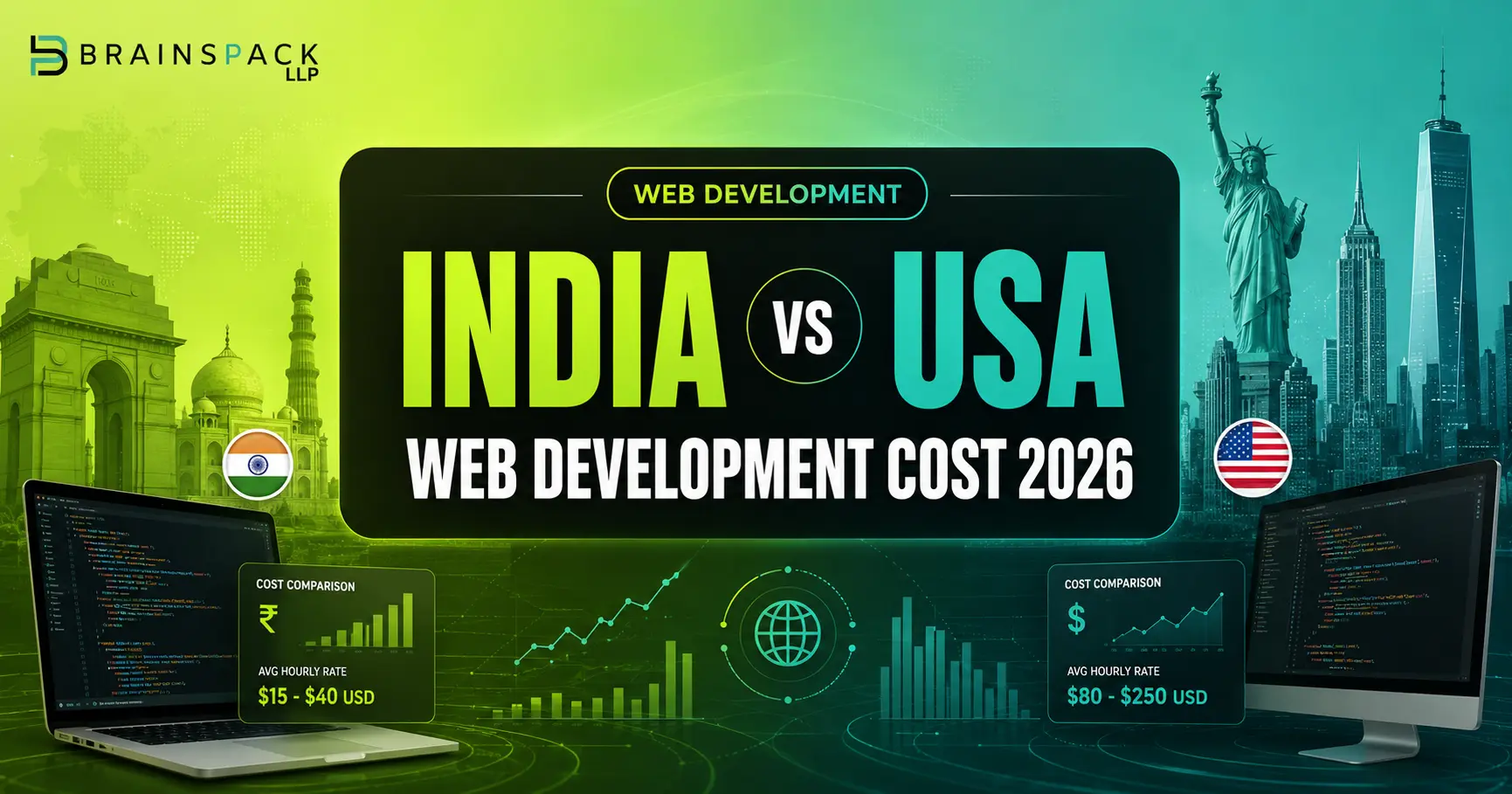
Q: Is web development cheaper in India than the USA? Yes, typically 60–75% cheaper. A US developer costs $100–200/hour, while a top Indian agency charges $25–65/hour for the same skill level and lower overhead. On a 500-hour project, that’s a saving of $50,000+.Q: Are Indian developers as good as US developers?
For most commercial web projects, yes. India produces over 1.5 million engineering graduates annually, many trained in modern stacks like React, Node.js, and Python. Top Indian developers routinely work with Google, Microsoft, and Silicon Valley startups.
Q: Why outsource web development to India?
Three reasons: 1) 60–75% cost savings versus US rates, 2) access to a large, English-speaking talent pool trained in all modern stacks, and 3) the time zone difference enables round-the-clock development cycles. With clear contracts and NDAs, the risks are fully manageable.
Q: Is outsourcing to India safe for my code and data?
Yes, when you work with a professional agency that signs enforceable NDAs (valid under the Indian Contract Act 1872), uses milestone-based payments, and follows ISO 27001 data practices. Choose agencies with arbitration clauses over low-bid freelancers for full legal protection.
| Q: Is web development cheaper in India than the USA? Yes, typically 60–75% cheaper. A US developer costs $100–200/hour, while a top Indian agency charges $25–65/hour for the same skill level and lower overhead. On a 500-hour project, that’s a saving of $50,000+.Q: Are Indian developers as good as US developers? For most commercial web projects, yes. India produces over 1.5 million engineering graduates annually, many trained in modern stacks like React, Node.js, and Python. Top Indian developers routinely work with Google, Microsoft, and Silicon Valley startups. Q: Why outsource web development to India? Three reasons: 1) 60–75% cost savings versus US rates, 2) access to a large, English-speaking talent pool trained in all modern stacks, and 3) the time zone difference enables round-the-clock development cycles. With clear contracts and NDAs, the risks are fully manageable. Q: Is outsourcing to India safe for my code and data? Yes, when you work with a professional agency that signs enforceable NDAs (valid under the Indian Contract Act 1872), uses milestone-based payments, and follows ISO 27001 data practices. Choose agencies with arbitration clauses over low-bid freelancers for full legal protection. |
If you’re a US business owner evaluating your web development options, you’ve probably done the math and felt the sticker shock. A mid-sized web project with a US agency can run $25,000–$80,000. The same project, built by a top-tier Indian development agency? $7,000–$20,000. Same deliverable. Same tech stack. Dramatically different invoice.
But cost is only part of the story. The real question serious founders ask is: can I trust the quality, the communication, and the legal safety? The answer, when you work with a professional Indian agency, is yes – and this guide will show you exactly why, with data, real numbers, and a clear process for getting it right.
Cost Comparison: India vs USA Developers (Real Hourly Rates)
Hourly Rate Comparison Table (2026)
| Role | USA Hourly Rate | India Hourly Rate (Top Agency) | Your Savings |
| Junior Developer | $75–$100 | $18–$28 | ~70% |
| Mid-Level Developer | $100–$150 | $28–$45 | ~68% |
| Senior Developer | $150–$200 | $45–$65 | ~65% |
| Full-Stack Lead | $175–$220 | $55–$75 | ~65% |
| UI/UX Designer | $90–$140 | $25–$50 | ~65% |
| DevOps / Cloud Engineer | $130–$180 | $40–$65 | ~65% |
These are agency rates for vetted senior talent – not rock-bottom freelancer pricing. If you see an Indian developer offering $8–$12/hour, that’s a red flag, not a deal. Professional agencies with strong processes, project managers, and QA teams charge $25–$65/hour, and that’s precisely the range that delivers consistent, enterprise-grade results.
Salary Comparison 2026 (Full-Time Hiring)
If you’re considering hiring a full-time developer rather than engaging an agency, here’s what the annual cost picture looks like:
| Role | USA Annual Salary (Total Cost) | India Annual Salary (Total Cost) | Savings |
| Mid-Level Developer | $120,000–$160,000 | $18,000–$30,000 | ~80% |
| Senior Developer | $160,000–$220,000 | $28,000–$45,000 | ~80% |
| Engineering Manager | $200,000–$280,000 | $40,000–$65,000 | ~78% |
US employer costs include salary, benefits, payroll taxes, office space, equipment, and recruiting fees. Indian costs include salary, statutory benefits, and standard overhead – all significantly lower due to cost-of-living differences, not skill differences.
How Much Can You Save Outsourcing to India? (Real Calculation)
Let’s run actual numbers on a 500-hour web application project:
- US Agency at $150/hr average = $75,000
- Indian Agency at $45/hr average = $22,500
- Total savings: $52,500 (70%)
For a startup or growing business, that $52,500 delta is your next marketing campaign, your infrastructure runway, or three months of operating capital. It’s not a rounding error – it’s a business decision.
Quality & Skill: Why Indian Developers Match (or Beat) US Counterparts
Quality of Indian Developers vs US Developers – The Data
The global software industry has already voted. India is the world’s largest technology outsourcing destination, not because it’s cheap, but because it consistently delivers. Here’s the evidence:
- India produces 1.5 million+ engineering graduates annually, with a significant portion specializing in software development, computer science, and IT systems.
- Indian developers are the largest national group on GitHub outside the United States, contributing to open-source projects across every major framework.
- Companies including Google, Microsoft, Adobe, Cisco, IBM, and hundreds of Silicon Valley startups maintain large, senior development centers in India – not as a cost play, but because the talent is genuinely world-class.
- The Indian IT export industry – led by companies like Infosys, Wipro, TCS, and HCL – generates $245+ billion annually, serving Fortune 500 clients across finance, healthcare, logistics, and e-commerce.
When a concern about “quality” arises, it’s almost always rooted in experience with low-bid, unvetted freelancers – not professional agencies. A $12/hour freelancer and a $50/hour senior developer at an established agency are entirely different products, regardless of geography.
English Proficiency & Communication Standards
India has one of the largest English-speaking populations in the world. English is the official language of business, government, and higher education across the country. Every engineering curriculum at a reputable Indian institution is taught entirely in English.
What this means practically: your daily standups, your Slack threads, your code documentation, your PR reviews – all in fluent, professional English. Timezone differences (more on this shortly) can be managed with async communication tools and structured handoffs, which professional agencies have perfected over decades of US client work.
Top Indian Talent Works with Global Fortune 500s
It’s worth repeating: the developers at top Indian agencies are often the same caliber of talent that Google and Microsoft recruit for their Bangalore and Hyderabad offices. Many senior developers at Indian agencies have previously worked at FAANG companies or US-headquartered technology firms. When you hire a professional Indian agency, you’re accessing that talent pool – at a fraction of the equivalent US cost.
Speed & Delivery: The Time Zone Advantage (Not a Disadvantage)
How the 9.5-Hour Time Difference Creates 24/7 Productivity
The most common concern about working with an Indian team is the time zone gap. The reality, once you experience it with a well-run agency, is the opposite: it’s a productivity multiplier.
Here’s how it works:
- Your US team wraps up for the day and hands off a list of tasks, bugs, or feedback.
- Your Indian team picks it up during their business hours (which overlap with your night).
- You wake up to completed work, reviewed PRs, and resolved tickets.
This is the follow-the-sun development model, and it’s why enterprises pay a premium to maintain globally distributed teams. A 2-week sprint that would take a co-located team 10 business days can move faster with an offshore team handling the overnight cycle.
Web Development Turnaround Time: India vs USA
For a typical MVP or web application build, here’s how timelines compare:
| Project Type | US Agency Timeline | Indian Agency Timeline |
| Landing page / marketing site | 2–4 weeks | 1–2 weeks |
| E-commerce store (custom) | 8–14 weeks | 6–10 weeks |
| SaaS MVP | 16–24 weeks | 12–18 weeks |
| Enterprise web application | 6–12 months | 5–10 months |
Indian agencies often move faster not just because of the timezone cycle, but because of the talent density – a single project frequently has dedicated frontend, backend, QA, and design resources working in parallel, whereas a small US agency might resource these roles sequentially.
Real Example: US Morning → India Evening Handoff
Here’s what a typical working day looks like for a US client with an Indian development partner:
8:00 AM EST – You join a 30-minute video standup with your Indian team lead. You review yesterday’s completed work, share feedback, and align on today’s priorities.
9:00 AM EST – Your team in India (it’s now 7:30 PM IST) starts executing on today’s deliverables. You go about your day.
5:00 PM EST – Your Indian team has just started their second half of the workday. Any urgent questions come through Slack or email.
9:00 AM EST next day – You log on to find completed features, test results, and documentation from overnight work.
That’s not a workaround. That’s an optimized delivery machine.
Legal & Contract Safety: How Smart US Clients Protect Their IP
Are NDAs Enforceable in India? (Yes – Under Indian Contract Act)
This is the question every serious US client asks, and the answer is unambiguous: yes, NDAs are fully enforceable in India under the Indian Contract Act, 1872 – one of the oldest and most comprehensive contract law frameworks in the world.
When you sign an NDA with a professional Indian agency, you have:
- A legally binding confidentiality obligation covering your IP, source code, business logic, and data.
- Remedies available through Indian civil courts, including injunctions and damages.
- The ability to include international arbitration clauses that provide neutral, efficient dispute resolution.
Professional agencies not only accept NDAs – they expect and welcome them. A signed NDA is a mark of a serious business relationship.
Why Arbitration (SIAC/Singapore) is Faster Than US Courts
Rather than relying on litigation in either US or Indian courts – both of which can take years – the gold standard for international contracts is international arbitration. Professional Indian agencies commonly agree to:
- SIAC (Singapore International Arbitration Centre) – fast, neutral, globally respected.
- LCIA (London Court of International Arbitration) – preferred for UK-adjacent deals.
- ICA (Indian Council of Arbitration) – suitable for India-specific disputes.
Arbitration under these bodies typically resolves in 12–18 months, versus 3–7 years in US federal courts. And critically, arbitration awards are enforceable in India under the New York Convention, to which India is a signatory.
Data Privacy – Using DPDPA & Contractual Safeguards
India’s Digital Personal Data Protection Act (DPDPA, 2023) establishes a national data protection framework that governs how Indian companies handle personal data. For US clients, this means:
- You can contractually require your Indian agency to comply with GDPR and CCPA standards via data processing agreements (DPAs).
- Reputable agencies operating at an enterprise level often hold ISO 27001 certification – the international standard for information security management.
- Your contract should include data handling clauses, breach notification obligations, and data return/destruction provisions – all of which professional agencies accept as standard.
Pro tip: Always use milestone-based payments and escrow for projects over $10,000. Not because you can’t trust your agency – but because it creates a clean, professional accountability structure that both sides benefit from.
Can You Sue an Indian Company for Breach of Contract?
Yes. Through arbitration or through Indian civil courts, you have full legal recourse. But more importantly, professional agencies are not in the business of breaching contracts – their entire business model depends on long-term US client relationships, referrals, and reputation. The incentive structures strongly favor delivery and professionalism.
The best protection is not litigation readiness – it’s prevention through process: clear Statements of Work, defined acceptance criteria, daily deliverable tracking, and a 2-week paid trial before committing to a full engagement.
Is Outsourcing to India Right for Your Business? (Decision Matrix)
When India Is the Best Choice
Outsourcing to a professional Indian agency is an excellent fit for:
- Startups building MVPs – You need to move fast, stay lean, and deploy capital efficiently. India gives you senior talent at startup-friendly rates.
- Scale-ups with growing engineering needs – You need to expand your team faster than US hiring allows. Offshore augmentation lets you scale in weeks, not quarters.
- E-commerce and SaaS businesses – Modern stacks (React, Node.js, Python, AWS, Shopify, etc.) are deeply familiar to Indian engineers who work on these daily.
- US companies with defined product specs – If you know what you want built, a well-run Indian agency will build it faster and cheaper than a US equivalent.
- Businesses that have outgrown freelancers – You need a team with project management, QA, and design – not a single contractor.
When You Might Still Hire Locally
There are genuine scenarios where local hiring or US-based agencies make more sense:
- US Government contracts – Many federal contracts require US-citizen developers with security clearances. This isn’t a preference – it’s a legal requirement.
- HIPAA-regulated healthcare data – While Indian agencies can build HIPAA-compliant systems contractually, some healthcare organizations prefer on-shore teams for compliance auditing simplicity.
- Defense and intelligence sector work – Classified work requires US-based teams, full stop.
- Early-stage co-founder dynamics – If you need someone in the room daily during intense 0-to-1 phases, proximity has genuine value.
For the vast majority of commercial web projects, none of these exceptions apply.
Real Cost Savings Example: 200-Hour Project
Let’s make the numbers concrete with a realistic mid-sized project: a custom web application with user authentication, a dashboard, API integrations, and admin panel – 200 hours of development.
| US Agency | Indian Agency | |
| Hourly Rate | $150/hr | $45/hr |
| Total Hours | 200 | 200 |
| Total Cost | $30,000 | $9,000 |
| Savings | $21,000 (70%) |
That $21,000 in savings is real working capital. It’s your paid media budget for the next quarter. It’s two additional months of runway. It’s the difference between launching with one feature set and launching with three.
How to Hire Indian Developers the Right Way (Avoid Common Mistakes)
5-Step Vetting Process for Offshore Success
Not all agencies are equal. Here’s how to identify and engage a professional Indian web development partner:
Step 1: Review their portfolio for US/EU client work. A credible agency has case studies showing projects for clients in your target market. Look for complexity, not just visual polish.
Step 2: Evaluate their communication in the first interaction. Response time, clarity, question quality, and professional tone in the first email or call tell you everything. If communication is poor before a contract, it will be worse during.
Step 3: Assess their process. Ask: What’s your sprint structure? How do you handle scope changes? What tools do you use for project tracking? A serious agency uses Agile methodology, Jira or Asana, GitHub with proper branching strategy, and daily standups.
Step 4: Check legal readiness. Do they have standard NDA and MSA templates? Can they accommodate international arbitration clauses? Do they accept milestone-based payment schedules? Yes to all three = professional firm.
Step 5: Run a paid trial. Before committing to a 6-month engagement, commission a 2-week paid trial project – a well-defined, scoped piece of work. This is the single best signal of real-world capability, communication, and delivery culture. Serious agencies welcome this.
Why Paid Trial Projects (2 Weeks) Eliminate Risk
A 2-week paid trial costs you $1,500–$4,000 depending on scope. It tells you more than 10 reference calls. You see:
- How they interpret and clarify requirements
- The quality and cleanliness of their code
- Their communication frequency and proactiveness
- How they handle a small scope ambiguity or bug
- Whether deadlines are treated as commitments or suggestions
If the trial is excellent, you’ve found a long-term partner. If it’s mediocre, you’ve spent $2,000 to save $50,000. That’s the best insurance policy in outsourcing.
Why US Companies Keep Coming Back to India (2026 Trends)
The India outsourcing story isn’t new – but in 2026, it’s stronger than ever. Several converging forces are driving more US businesses toward Indian development partners:
AI-augmented development has made Indian developers more productive per hour, not less. Top Indian engineers are early and heavy adopters of Copilot, Cursor, and other AI coding tools, which means faster delivery at the same quality bar.
Remote-first culture normalization post-2020 has eliminated the psychological friction of offshore work. US companies that resisted remote teams before COVID now manage fully distributed engineering organizations. Adding an India-based team is no longer a cultural stretch – it’s a natural extension.
US hiring market pressure continues to make senior engineering talent expensive and hard to retain domestically. Indian agencies offer a stable, scalable alternative to the constant churn of US tech hiring.
Improved tooling for async collaboration – tools like Linear, Notion, Loom, Slack, and Figma have made timezone-distributed development smoother than it has ever been.
Repeat client rates at professional Indian agencies are consistently high – typically 70–85%. That’s not a statistic about cheap pricing. That’s a statistic about results.
Frequently Asked Questions
Why are Indian developers so affordable? It comes down to cost of living, not cost of skill. A senior Indian developer with 8 years of experience lives very comfortably on $30,000–$45,000 per year. Their US equivalent needs $160,000–$200,000 to maintain a comparable lifestyle. You’re paying for expertise, not a zip code.
Do Indian developers miss deadlines? At the agency level – with Agile processes, project managers, daily standups, and defined deliverables – deadline adherence is strong. The timezone difference actually helps: your morning review is their evening deployment. Delays happen in web development everywhere in the world; the difference is whether your agency has the processes to surface them early and course-correct fast.
What tech stacks are Indian developers strongest in? Indian developers are proficient across all major modern stacks: React, Next.js, Vue, Angular, Node.js, Python (Django/FastAPI), PHP (Laravel), Ruby on Rails, AWS, GCP, Azure, React Native, Flutter, Shopify, WordPress, and more. For any standard commercial web project, you’ll find deep expertise.
How do I know I’ll own my code? Your contract should explicitly state that all IP – code, designs, documentation – transfers to you upon final payment. This is standard in any professional agency agreement. Add a clause requiring IP assignment confirmation in writing at project close.
Ready to Save 70% on Development Without the Risk?
The math is clear. The talent is real. The legal framework is solid. What separates a successful offshore engagement from a frustrating one isn’t geography – it’s choosing the right agency, establishing the right processes, and starting with a defined trial.
A professional Indian web development agency gives you:
- Senior developers in React, Python, Node.js, and more
- Daily video standups and Slack-based communication
- Signed NDA + IP assignment + milestone-based payments
- Agile project management with transparent tracking
- 60–75% cost savings versus equivalent US agency rates
Want an exact price comparison for your project? Get a free India vs USA cost estimate and see your real savings.
Book a free 30-minute consultation.
We’ll walk through your project scope, show you a realistic budget comparison, and give you a no-obligation proposal – so you can make this decision with full information.