

By Varun Prashar – 12+ yrs engineering + deep AI expertise, fast AI-assisted development, across fintech/healthcare/e-commerce
Updated: June 2026 · 12 min read
| No-code AI is your best friend for fast, affordable MVPs and internal tools. Custom AI wins when you need full data ownership, proprietary models, and the ability to scale to millions of predictions. If you’ve checked even two boxes in the “I need control” column, you should start with custom – migrating later costs 3–5x more than building right the first time. |
What is No-Code AI vs Custom AI? (Plain English)
Every business evaluating AI in 2026 faces the same fork in the road: do you grab an off-the-shelf tool and launch in days, or do you invest in something built specifically for your needs?
Neither answer is wrong. But picking the wrong one for your situation will cost you – either in wasted time, wasted money, or both.
No-Code AI – Drag, Drop, Deploy
No-code AI platforms let you build AI-powered workflows, chatbots, automation sequences, and basic predictive models without writing a single line of code. Tools like Bubble, Botpress, Make.com, Airtable, and Zapier sit in this category. You connect blocks, configure logic, and deploy – sometimes in days.
The appeal is obvious: no ML engineers required, low upfront cost (typically $50–$500/month), and your ops or marketing team can build and iterate independently. For a non-technical founder validating an idea, this is genuinely powerful.
Custom AI – Built from Scratch for You
Custom AI development means building AI models, infrastructure, and integrations tailored specifically to your business. This includes training proprietary machine learning models on your own data, building custom APIs, designing scalable inference pipelines, and owning every layer of the stack.
The timeline is longer (8–20 weeks for an MVP), the upfront cost is higher ($30K–$200K+), and you’ll need ML engineers and data scientists. But what you get in return is a system that does exactly what your business needs – and that no competitor can replicate by subscribing to the same platform.
| Not sure which side of the line you’re on? Check the signals that apply to your business – takes 60 seconds and tells you whether you’re building on the wrong foundation. → Check my AI signals |
Key Differences Between No-Code AI and Custom AI
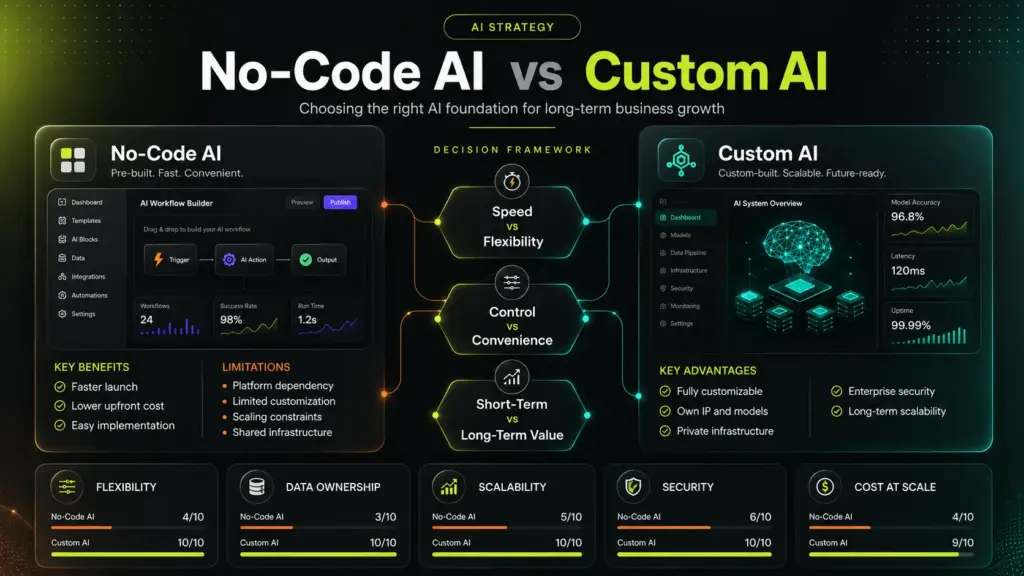
Understanding where these two approaches diverge helps you make a clear-headed decision rather than a budget-driven one.
Flexibility and Customization
No-code platforms give you templates, pre-built logic blocks, and a ceiling. That ceiling is the platform’s own design choices. You can customize within their constraints – but the moment you need something outside those constraints, you’re stuck with workarounds that accumulate technical debt over time.
Custom AI has no ceiling. You build any feature, any algorithm, any workflow your business requires. If your use case is standard, no-code is fine. If your use case is the core of your competitive advantage, standard isn’t good enough.
Data Privacy and Ownership
This is where no-code platforms carry a risk most businesses underestimate. When you train a model or run predictions on a no-code platform, your data often lives on their cloud infrastructure. You may not fully control how it’s stored, processed, or used. GDPR compliance, HIPAA requirements, and data sovereignty laws become much harder to guarantee when you don’t control the backend.
Custom AI gives you full data ownership. Your training data, your model weights, your inference infrastructure – all under your control, behind your security perimeter. For healthcare, fintech, legal tech, or any business handling sensitive customer data, this isn’t optional. It’s essential.
Performance and Scalability
No-code platforms handle moderate workloads well. Under 50,000 API calls per month? You’ll rarely hit meaningful performance limits. But beyond that threshold, the architecture starts showing cracks. Vendor pricing tiers kick in aggressively, latency increases, and you discover that the platform wasn’t designed for your scale – it was designed for the average customer.
Custom AI infrastructure scales predictably. With proper architecture – load-balanced servers, CDN, caching, Kubernetes orchestration – you can serve thousands of concurrent users and process millions of predictions per day at a marginal cost per transaction that decreases as volume grows.
Cost Comparison: No-Code AI vs Custom AI
Cost is the first question every founder asks. The honest answer: it depends entirely on your time horizon.
No-Code Pricing Models ($50–$2,000/month)
The entry cost for no-code AI is low. A typical startup setup might run:
- Monthly subscription: $50–$500 depending on usage tier
- Setup and integrations: $3K–$8K in year one
- Hidden costs – API overages, extra features, integration workarounds: $3K–$15K annually
A growing startup spending $500/month on no-code platforms spends roughly $6K–$24K in year one. That feels manageable.
The problem is what happens in year two and three. No-code pricing is volume-based. As your user base and prediction volume grow, your monthly bill grows linearly – and then exponentially when you breach pricing tiers. By year four, many businesses are spending $8K–$16K per month on no-code platforms that are simultaneously constraining what their product can do.
Custom AI Development Cost ($30K–$200K+)
Custom development front-loads the investment. A realistic breakdown:
- Requirements and planning: $2K–$10K
- Data preparation: $5K–$50K
- Model development: $10K–$100K
- Testing and QA: $5K–$15K
- Deployment: $2K–$5K
- Ongoing maintenance: $3K–$9K per month
A mid-complexity custom AI project runs $50K–$300K in year one, with a 5-year total of $150K–$350K including maintenance.
| The break-even point isn’t the same for every business. Plug in your current no-code spend, prediction volume, and growth rate – and see exactly when custom AI pays off for your numbers. → Model my 5-year cost |
When Custom AI Delivers Better ROI
The break-even point is around $15K/month in no-code spend. Below that threshold, no-code is almost always cheaper in absolute terms. Above it, custom development typically becomes more cost-effective within 12–24 months – because you stop paying per-prediction fees and gain infrastructure whose marginal cost decreases with scale.
For high-volume, high-frequency use cases, custom AI delivers 3–5x better ROI at scale. The fintech that runs 2 million predictions per day simply cannot afford to do that on a no-code platform. The cost structure doesn’t work.
When No-Code AI Makes Sense (Honest Take)
No-code AI gets a bad reputation in technical circles, but that reputation is largely unfair. For the right use cases, it’s the smartest move you can make.
Best for Startups Validating an AI MVP
If you don’t yet know whether your customers will pay for your AI feature, you have no business spending $100K building it from scratch. No-code lets you validate the idea, measure conversion, collect real user feedback, and iterate – all within weeks and on a lean budget.
A non-technical founder who used no-code AI platforms to build a marketing automation service reached $10K MRR within six months without writing a line of code. The key insight: no-code enabled speed-to-market that custom development simply couldn’t match at that stage.
Internal Tools and Simple Automations
Invoice processing. Document classification. Internal chatbots. Customer support triage. These are use cases where no-code AI genuinely shines. The data is relatively standardized, the volume is moderate, and you don’t need a proprietary model – a well-configured no-code solution performs just as well.
Non-Sensitive Data and Standard Use Cases
If your AI use case doesn’t involve sensitive personal data, doesn’t require custom algorithms, and serves a volume under 50,000 predictions per month, no-code is your best option. Faster to build, cheaper to run, and easier for non-technical teams to maintain.
When Custom AI Development is Better
There are clear signals that no-code is the wrong tool. If you recognize your situation in any of the following, you should be planning for custom development – not continuing to build on a platform you’ll outgrow.
You Need Full Control Over Your AI Model
Your AI model is your product. Every design choice, training decision, and optimization should reflect your specific business problem – not the platform’s default approach. No-code platforms use pre-trained models with limited fine-tuning options. Custom development means training on your proprietary data, optimizing for your specific metrics, and owning the intellectual property.
When investors evaluate your business, “we built on top of a commodity AI platform” is a very different story than “we trained a proprietary model on 3 years of domain-specific data that our competitors can’t replicate.”
You Handle Sensitive Customer Data
Healthcare. Fintech. Legal. Education. Insurance. If your business operates in regulated industries, data sovereignty isn’t a preference – it’s a legal requirement. No-code platforms often cannot guarantee GDPR, HIPAA, or SOC2 compliance at the infrastructure level. The compliance burden falls on you, but you don’t control the backend. That’s a dangerous combination.
Custom AI lets you build within your security perimeter, choose your hosting region, implement access controls, run security audits, and provide the documentation regulators require.
You Plan to Scale to Millions of Predictions
At 10,000 predictions per month, no-code works fine. At 10 million, you’re looking at latency issues, cost explosions, and architectural limitations that no workaround can solve. The platform was never designed for your scale.
One retail business built an AI recommendation engine on no-code tools that was processing 2 million AI predictions per day across 15,000+ merchants, while growing inventory data to 50 million records. No-code platforms scaled reasonably up to a point – but the moment they needed custom algorithms for specific inventory calculations and deeper legacy system integrations, the platform simply couldn’t deliver.
You Want a Competitive Moat
If AI is central to your value proposition – not just a feature you bolted on – then using the same platform as every other startup in your space is actively dangerous. Your competitors have access to the same tool, the same models, the same capabilities. There’s no differentiation to be found there.
Custom AI lets you build something no one else has. That’s what creates a competitive moat: proprietary data, proprietary models, and capabilities that can’t be replicated by subscribing to a SaaS platform.
Limitations of No-Code AI (The Hidden Costs)
The monthly subscription is the price you see. The real costs are less visible – until they hit you.
Vendor Lock-In and Data Ownership Risks
No-code platforms use proprietary logic blocks, proprietary data formats, and proprietary AI models. When you decide to migrate – and eventually, most scaling businesses do – you can’t export your workflows and port them over. You’re effectively starting from scratch. The rebuild cost typically runs $30K–$80K in unexpected migration effort, not counting the 6–12 months of lost engineering time.
One e-commerce startup experienced this firsthand: their entire chatbot was built on platform-specific logic blocks and proprietary AI models. Moving to custom meant rebuilding every workflow from the ground up.
Poor Performance at Scale
No-code connectors work for common platforms, but businesses often need deep integrations with legacy on-premise systems, custom APIs, or unusual data sources. When the integration isn’t natively supported, you’re blocked. When it is supported but imperfect, you build manual workarounds – workarounds that accumulate and become increasingly fragile over time.
Meanwhile, platform pricing compounds. A no-code tool priced fairly at $500/month at 10,000 users becomes genuinely expensive at 200,000 users – and the performance doesn’t scale proportionally.
Can’t Customize Beyond Pre-Built Blocks
No-code platforms give you templates and logic blocks. Once you need specialized computations, unique data modeling, or algorithms that don’t fit into the pre-built options, you’re forced into unmaintainable workarounds. These workarounds often break when the platform updates its underlying infrastructure – which it does on its own schedule, not yours.
Can No-Code AI Scale? (Real Answer)
The question founders always ask. Here’s the direct answer.
For 10K Requests Per Month – Yes
At modest volume, no-code platforms are genuinely capable. The AI works, the response times are acceptable, the cost is reasonable. For validating your concept, serving early customers, and iterating quickly, no-code scales just fine.
For 10M Requests Per Month – Rarely
At enterprise scale, no-code platforms consistently fail to deliver on four dimensions: they hit usage and pricing limits that make costs prohibitive, they can’t connect to legacy or custom systems at the depth enterprise clients require, they use pre-trained models that can’t be fine-tuned on your proprietary domain data, and their vendor pricing grows linearly while your infrastructure costs should be growing sublinearly.
A useful signal: when 60% of your IT team’s time is spent managing no-code platform limitations rather than building new features, you’ve outgrown the tool.
How to Choose the Right AI Approach (Decision Framework)
Before committing to either path, ask yourself five questions honestly.
1. What is my current budget? If you have less than $10K upfront, custom development isn’t feasible yet. If you’re spending more than $15K per month on no-code platforms, custom is almost certainly overdue.
2. How sensitive is my data? If HIPAA, GDPR, or SOC2 compliance is required, you need infrastructure you control. No-code rarely provides the necessary guarantees.
3. Is AI a feature or my product? If AI is peripheral to your offering, no-code is fine. If AI is the reason customers pay you, it needs to be something you own and control.
4. What is my prediction volume? Under 50,000 monthly predictions: no-code works. Over 1 million: plan for custom infrastructure.
5. Do I need a competitive advantage from AI? If yes, you cannot build that advantage on a tool your competitors can subscribe to tomorrow.
Quick Decision Table
| If you want… | Choose No-Code AI | Choose Custom AI |
| Fast MVP (under 4 weeks) | Yes | No |
| Low upfront cost (under $10K) | Yes | No |
| Full data ownership | Risky | Yes |
| Scale to millions of requests | No | Yes |
| Proprietary AI model | No | Yes |
| HIPAA / SOC2 compliance | Rarely | Yes |
| Competitive moat from AI | No | Yes |
If you checked even two boxes in the Custom AI column, you should start there. Migrating from no-code to custom later costs 3–5x more than building correctly the first time.
The Hybrid Approach: No-Code + Custom AI
The smartest founders don’t think of this as a binary choice. They treat no-code as a validation tool and custom as the destination.
Start with No-Code, Migrate to Custom
The right hybrid strategy follows a predictable arc. Use no-code AI for months 0–6 to prove product-market fit and measure actual spend. Track your monthly costs carefully – alert yourself at $10K/month. Document every workflow as if you’ll rebuild it tomorrow. Keep your data in standard formats you control, not platform-specific storage.
Build custom when spending hits $15K/month consistently, when you’re processing millions of transactions, or when AI becomes your core differentiator rather than a supporting feature.
Using No-Code for Front-End, Custom for Core Models
One effective pattern: keep no-code for the interfaces and workflows that don’t require proprietary logic – user onboarding, admin dashboards, standard integrations – while running your core AI inference on custom infrastructure. This approach lets non-technical team members maintain the parts of the product they understand, while your engineering team focuses on building and optimizing the AI layer that drives real competitive value.
A real example of this working: an AI chatbot startup built on Bubble for the front-end and onboarding logic while using OpenAI’s API for the underlying language model. They reached 40,000 users and $25,000 monthly recurring revenue in months – not years. The key lesson: combining no-code with best-in-class AI APIs can be a durable strategy, at least until your volume demands a fully proprietary approach.
| Already on a no-code platform and wondering if it’s time to migrate? Score your current setup across 7 signals – from monthly spend to data compliance gaps – and get a clear migrate/wait recommendation. → Score my migration readiness |
Real Example: From No-Code MVP to Custom AI at Scale
A fintech startup built a customer support chatbot using no-code AI platforms. In the first six months, the results were impressive: handling 40–60% of support inquiries, saving $42,000 annually, rapid iteration based on customer feedback.
Then growth happened.
As the platform scaled beyond 40,000 users, they hit workflow timeout limits and database performance ceilings at around 500,000 records. Chatbot response time increased from 2 seconds to 8+ seconds during peak usage, causing customer complaints and measurable churn.
The migration strategy they chose was smart: they kept the no-code front-end (user-facing interfaces) because it was working, migrated only the AI processing layer to custom infrastructure, and retained the API connection for the language model rather than rebuilding it prematurely.
The results after the hybrid migration: response time dropped from 8+ seconds to 1.5 seconds (5x faster), concurrent user capacity jumped 10x, database records scaled to 5M+, and monthly infrastructure costs actually decreased from $8,000 to $6,500 – a 19% saving despite the dramatically improved performance.
The key lesson: don’t rewrite everything. Migrate only the performance bottleneck, keep what works.
Ready to Build Custom AI? Here’s What to Expect
If you’ve made the decision that custom is right for your business, here’s a realistic picture of what the journey looks like.
Timeline, Team, and Budget Breakdown
A mid-complexity custom AI project runs 18–35 weeks from kickoff to production. The core team you need includes an AI/ML engineer (the most critical hire – generalists cannot build production ML systems), a backend developer, a data engineer or data scientist, and a DevOps engineer for infrastructure.
For a startup using an agency model – the fastest path to launch without building an in-house team first – expect $30K–$200K for the end-to-end build, with $3K–$9K per month in ongoing maintenance and support. Full IP transfer, scalable cloud infrastructure on AWS, Azure, or GCP, and end-to-end model development from data pipeline to inference API should all be part of what you receive.
The smartest founders validate revenue with no-code first, then move to custom development after proving their model – when they have capital to invest and the confidence that the investment will pay back.
Not sure which path fits your budget and timeline? We help businesses audit their AI needs and map the most efficient path from idea to production. Whether you’re at the no-code stage or ready to build something proprietary – we’ll give you an honest answer, not a sales pitch.
| You’ve read the framework. Now apply it to your actual stack. In 15 minutes, we’ll tell you whether no-code, custom, or hybrid fits your stage – based on your data sensitivity, prediction volume, and budget. No pitch, no pressure. → Get my free AI roadmap |
Frequently Asked Questions
Is no-code AI enough for my business? Yes – if you’re building a simple MVP, internal tool, or prototype with fewer than 10,000 monthly predictions and no sensitive data. No-code fails when you need custom logic, high scale, or data privacy guarantees.
When should I build custom AI? Build custom AI when you need full data ownership, proprietary models, millions of predictions per day, or integration with existing enterprise systems. Also build custom when your business advantage depends on AI accuracy and differentiation – not just AI availability.
What are the limitations of no-code AI tools? No-code AI limits you to pre-built templates, often takes ownership of your training data, and breaks at scale. You cannot add custom algorithms or fine-tune models beyond what the platform allows. Migration away from no-code platforms is expensive and time-consuming because workflows are built on proprietary logic that can’t be ported.
Can no-code AI scale? For small volumes under 50,000 API calls per month, yes. For enterprise-scale operations – millions of predictions, low latency requirements, high availability – no. You need custom infrastructure designed for your specific load profile.
Is custom AI worth the investment? Yes, if your AI feature is core to your product. Custom AI pays back through better accuracy, lower per-prediction costs at scale, full data ownership, and the ability to build a competitive advantage that can’t be replicated by a competitor subscribing to the same platform you’re using.
The Bottom Line
No-code AI is a legitimate, powerful tool – and using it for the right problems is a sign of good judgment, not laziness. The best founders in 2026 use no-code to validate fast, measure carefully, and migrate strategically when the business signals are clear.
Custom AI is not for everyone. But if data ownership matters, if scale is in your roadmap, if AI is your core differentiation – then building on a platform you don’t control is a risk you’re taking on knowingly.
The decision isn’t really about technology. It’s about where you are in your journey, what you’re trying to prove, and how central AI is to the business you’re building.
Start right. Scale smart. And if you’ve already hit two of those boxes in the Custom AI column – the clock is ticking.
Ready to build custom AI that actually scales?
We’re a custom AI development agency that works with startups and growth-stage businesses to build AI systems they own, control, and can scale. You’ll get end-to-end model development, full data ownership and IP transfer, and scalable infrastructure on the cloud platform that fits your stack.